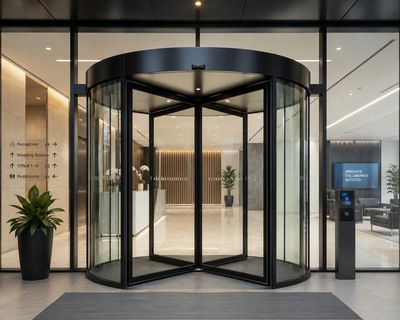
Automatic Revolving Doors by Hectafine
Few entrance systems make as strong an architectural statement as the Automatic Revolving Door, and for buildings that need to balance grand visual impact with serious energy performance, it remains the gold-standard choice. The design is built around two, three or four wings rotating together within a circular glass enclosure, driven by a microprocessor-controlled motor connected to an overhead ring-gear drive. Because at least one wing is always positioned between the interior and exterior compartments as the door rotates, the building's conditioned air is never directly exposed to outside weather the revolving chamber functions as a continuous air-lock, which is the core reason this door type is so often specified for prestige lobbies in extreme climates, including the hot, dust-laden summers and air-conditioning-dependent interiors common across Indian cities.
Manufacturers in this category compete heavily on diameter and aesthetics: oversized revolving doors with frameless glass wings and slim canopy structures have become a signature offering among premium European brands, allowing architects to specify a revolving entrance that reads as a sculptural glass drum rather than a purely mechanical assembly. Beyond the energy story, revolving doors offer a quietly important security benefit: because pedestrians pass through one compartment at a time, the door naturally regulates and meters entry, making tailgating and unauthorised mass entry significantly harder than at a wide-open sliding entrance. This is one reason banks, corporate headquarters and five-star hotels where controlled access and a sense of occasion both matter gravitate toward revolving doors for their primary entrance, often pairing them with a secondary swing or sliding door alongside for wheelchair access, deliveries, and high-volume periods.
From a buyer's perspective, the principal decisions are the enclosure diameter and wing count (which together determine pedestrian throughput), rotation speed, and the safety package finger-protection sensors along every leading edge, speed governors that prevent over-acceleration, emergency stop controls, and anti-panic break-out wings that allow the entire assembly to fold flat in a crowd-evacuation scenario are all standard expectations on a quality installation today, and are validated against the same EN 16005 and EN 13849 safety standards that govern sliding and swing operators. A lockable night-security mode is also worth specifying, since it allows the revolving door to double as an after-hours security barrier without needing a separate shutter.
While revolving doors carry a higher upfront investment than sliding or swing systems and need a larger floor footprint, the combination of lower long-term HVAC costs, enhanced security, and undeniable architectural presence makes them a compelling choice wherever the lobby itself is meant to make an impression on every visitor who walks through it.
Specifications
- Door Type : 2-wing / 3-wing / 4-wing automatic revolving door
- Diameter : 2000 mm – 4000 mm (standard); larger custom diameters available
- Height : Up to 3000 mm (standard); taller bespoke units on request
- Drive Mechanism : Microprocessor-controlled motor drive with overhead ring gear
- Rotation Speed : Adjustable, typically 1–3 rpm
- Activation : Motion sensor, radar, push button, manual rotation override
- Safety Sensors : Finger-protection sensors, speed governors, emergency stop, anti-panic break-out wings
- Power Supply : 220–240V AC, single phase
- Glazing : 8 mm to 12 mm toughened/laminated glass wings
- Enclosure Material : Aluminium/stainless steel framed canopy with glass cladding
- Night Security Mode : Lockable wings for after-hours closure
- Certifications : CE / EN 16005 compliant operator
- Operating Temperature : -15°C to +50°C
Reach Out to Us!
Reach out to us for your requirement for automatic revolving door solutions. Our team would support you with design & consultation tailored to your project needs.
Advantages of Automatic REVOLVING Doors
- Low-energy operation suitable for ADA/barrier-free accessibility
- Compatible with existing manual door leaves for easy retrofitting
- Compact footprint no track or pocket space required
- Concealed operator option preserves clean architectural lines
- Cost-effective automation for single and double-leaf entrances
- Smooth obstruction detection ensures safe operation in busy areas