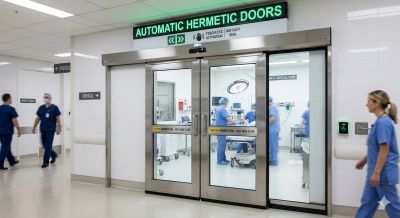
Automatic HERMETIC by Hectafine
Some entrances exist purely to keep people moving comfortably; the Hermetic Door exists to keep air, dust and contaminants exactly where they are supposed to be. Built on a sliding-door platform but engineered with a unique, often patented sealed-track system and a compression-seal mechanism along the head, jamb and sill, a hermetic door closes to form a near-complete airtight barrier rather than the small gaps that a standard sliding or swing door leaves around its edges. This level of air-tightness is essential in any space where pressure differentials must be maintained (positive pressure in an operation theatre to keep contaminants out, or negative pressure in an isolation ward to keep them in), and it is also why hermetic doors are specified throughout cleanrooms, laboratories and pharmaceutical manufacturing areas where even small amounts of air leakage can compromise sterility or product quality. By sealing this tightly, the door also meaningfully reduces the air-handling load on a facility's HVAC system, since conditioned air is no longer leaking out through the doorway every time someone passes through.
Hygiene goes beyond the seal itself. Hermetic doors are designed for dry-room operation with smooth, crevice-free profiles that leave no ledges or gaps where dust, fluids or pathogens can collect, making routine disinfection far simpler and more reliable than with a conventional framed door. Many healthcare-grade models also offer antimicrobial-coated surfaces and stainless-steel cladding options as an additional layer of protection in critical-care environments, directly reducing the risk of wound infections and cross-contamination between wards. Activation is almost always touch-free by design foot switches, elbow switches, wave sensors, or full integration with access control since the entire point of the door is to minimise hand contact and the transfer of contamination in exactly the spaces where infection control matters most.
From an operational standpoint, the motor and controller are tuned for soft-start and soft-stop motion rather than the faster, snappier cycling you might want at a retail entrance patients, trolleys and medical staff moving through an ICU or OT corridor benefit from a gentler, more predictable door cycle. When specifying a hermetic door, the key considerations are the required pressure-differential performance for the room (which should be confirmed against the facility's HVAC and infection-control design), the opening width needed to comfortably pass hospital beds and equipment trolleys, and whether cleanroom-grade certification is required for the specific application. Though hermetic doors sit at a higher price point than standard sliding doors, in healthcare and life-science facilities they are not an optional upgrade they are a fundamental part of the infection-control and sterility infrastructure of the building.
Specifications
- Door Type : Single slide / bi-parting hermetically sealed sliding door
- Maximum Panel Weight : Up to 220 kg per panel
- Opening Width : 700 mm – 2000 mm
- Opening Height : Up to 2500 mm
- Sealing Mechanism : Compression seal on head, jamb & sill tracks (patented sealed-track design)
- Air Leakage Performance : Near-zero air leakage when closed (suitable for positive/negative pressure rooms)
- Drive Mechanism : Microprocessor-controlled motor with smooth soft-start/soft-stop
- Activation : Touchless sensor, foot switch, elbow switch, hand-wave sensor, access control
- Hygiene Features : Antimicrobial-coated surfaces (optional), smooth crevice-free profiles for easy disinfection
- Power Supply : 220–240V AC, single phase
- Glazing : 6 mm to 10 mm toughened/laminated glass with sealed glazing gaskets
- Frame Material : Powder-coated aluminium / stainless steel cladding (cleanroom-grade option)
- Certifications : CE / ISO 14644 cleanroom-compatible / DIN 18650
- Operating Temperature: -10°C to +45°C
Reach Out to Us!
Reach out to us for your requirement for automatic hermetic door solutions. Our team would support you with design & consultation tailored to your project needs.
Advantages of Automatic HERMETIC Doors
- Near-zero air leakage maintains sterile, pressure-controlled environments
- Reduces cross-contamination risk in OTs, ICUs and cleanrooms
- Touchless activation options improve infection control
- Crevice-free, antimicrobial-ready surfaces simplify disinfection
- Soft-start/soft-stop motion ensures patient and staff safety
- Compliant with cleanroom and hospital hygiene standards